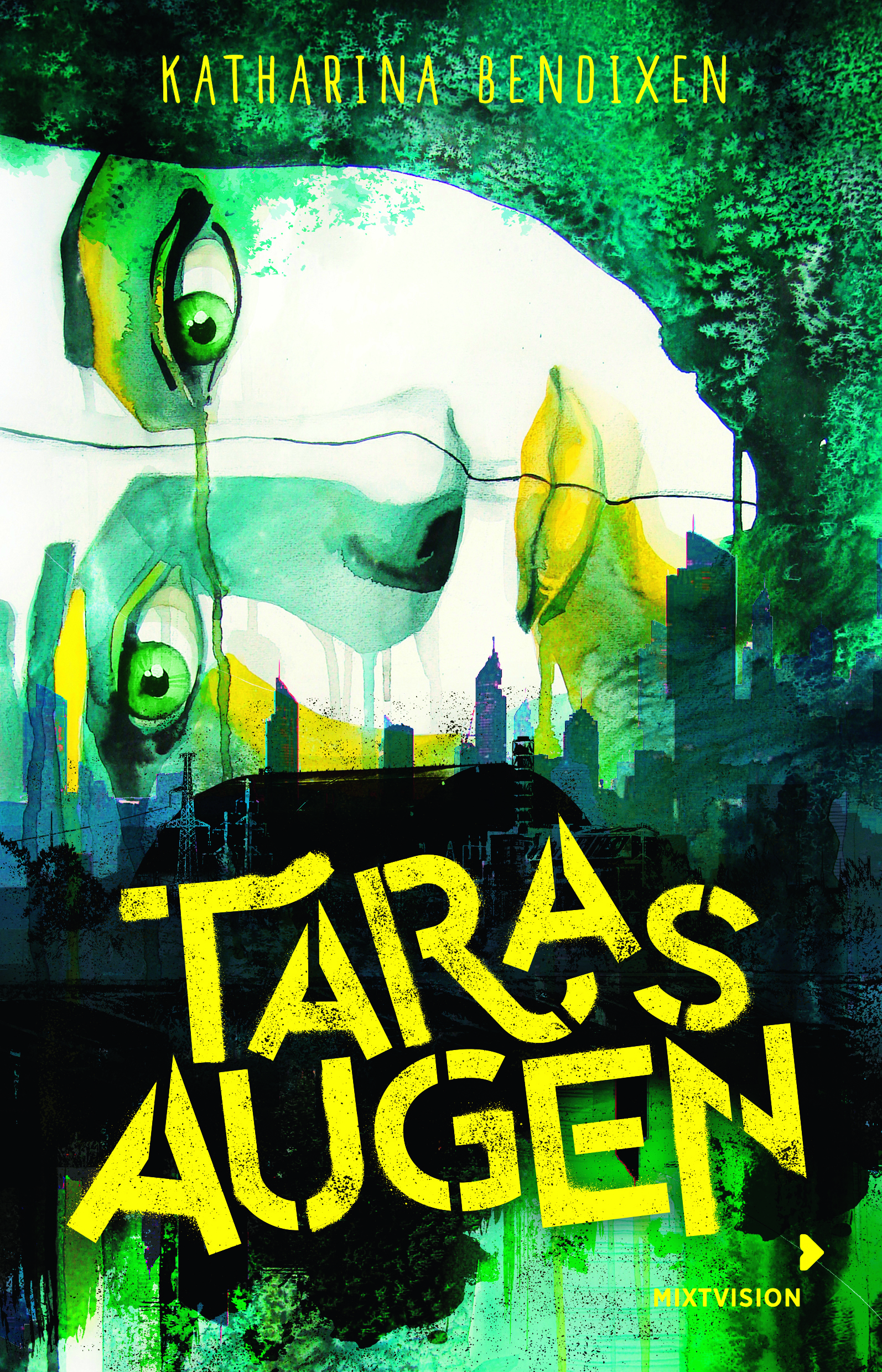
Katharina Bendixen’s Taras Augen is, on the surface, a near-future coming-of-age story shaped by a catastrophic industrial accident: an explosion in a chemical plant releases a toxic cloud, a region is evacuated, and two teenagers—Tara and Alún—are separated in the aftermath. But the novel’s real engine is not only catastrophe; it’s visibility: surveillance, erasure, witnessing, and the fragile, stubborn practice of keeping someone (and something) in view.
This is why Taras Augen works so well as ecofiction—not because it “delivers a message,” but because it stages the Anthropocene as an experience of fractured perception: the disaster is everywhere, yet accountability is nowhere; life continues, yet nothing is stable; people adapt, yet the conditions of adaptation are deeply unequal.
A story split by zones—and by access
Bendixen builds a world of separation that feels disturbingly plausible: after the accident, the characters’ lives reorganize around zones, bureaucratic language, and new rules of movement. Tara ends up returning to the contaminated area with her family for financial reasons, while Alún’s family manages a restart in a safer, intensely controlled city.
That difference matters. Taras Augen doesn’t treat catastrophe as a single event that “happens to everyone.” It foregrounds what environmental justice scholars have said for decades: risk and recovery are distributed along lines of wealth and power. Some people can leave. Others are pushed back into danger.
And then there’s the other layer: the sense that the official story doesn’t add up, that the accident is being managed not only materially but narratively—through silence, normalization, and controlled information.
The eyes as motif: visual narrative, semiotics, and a politics of attention
The title is not subtle—and it doesn’t need to be.
Alún, unable to let Tara disappear, begins placing images of Tara’s eyes across the city as a form of street art: tiles with her gaze, distributed through urban space. It’s a striking gesture because it’s at least three things at once: a love story (a risky attempt to reconnect), a visual intervention (art that insists on presence), and a semiotic act (a sign that pulls meaning into motion).
Eyes are never “just eyes.” They are symbols of intimacy and vulnerability, but also of control: cameras, watchtowers, algorithms, the constant hum of being observed. In a near-future setting shaped by surveillance and regulation, Tara’s eyes become a counter-gaze—something like: I am still here. I am not fully removed. I am not fully erased.
And that’s where the novel quietly touches one of the core problems of the Anthropocene: how certain harms become visible while others are made ordinary, postponed, denied, or aesthetically managed. We often speak of the climate crisis as a crisis of carbon—fair. But it’s also a crisis of representation: what counts as evidence? which images circulate? whose suffering is shown, and whose is absorbed into background noise?
Ecofiction that doesn’t resolve neatly—and why that matters
Many dystopias train us to expect a clean arc: from revelation to resistance to overthrow (or collapse). Taras Augen moves differently. It is less interested in heroic clarity than in the slow, messy reality of living after rupture—conflict, avoidance, guilt, longing, exhaustion. Reviews have noted that the book leaves some tensions unresolved and holds a lot in the background, including the broader structures behind the disaster.
For me, that’s not a weakness. It’s a choice with Anthropocene accuracy.
Because the Anthropocene rarely delivers tidy endings. It delivers partial knowledge, delayed consequences, and the kind of everyday coping that can look like apathy from the outside—but is often just survival. Tara’s return to the contaminated zone is not framed as a symbolic decision. It is economic necessity. That realism matters.
Ecofiction, at its best, doesn’t just warn. It helps us practice perceiving the ethical texture of a world where continuation can be complicity, where “moving on” might require forgetting, and where remembering has a cost.
Heritage thoughts: what survives, what is sacrificed
Reading Taras Augen through a cultural heritage lens, I kept thinking about a familiar question in heritage debates: what do we preserve, and what do we abandon? After industrial disaster, the world becomes a contested archive: zones, ruins, toxicity, displaced communities, the politics of return.
Here, heritage isn’t only old stones; it’s the fragile continuity of ordinary life—friendship histories, local landscapes, swimming spots, family routines, the memory of “before.” Taras Augen turns those everyday attachments into something serious: not nostalgia, but evidence of what is at stake when environments are rendered unlivable.
And the eye-tiles (again!) act a bit like portable heritage: small, repeatable fragments that carry affect and memory into new spaces. They don’t “solve” anything—but they refuse erasure.
Why I’d teach this book
If you teach Environmental Humanities, cultural studies, or literature/media in sustainability contexts, Taras Augen offers a lot:
- Anthropocene literacy without didacticism: risk, contamination, displacement, inequality
- A vivid entry into politics of representation: visibility, surveillance, public narrative
- A strong case for visual narrative analysis: the eyes as sign, street art as counter-archive
- A chance to discuss future-making beyond tech optimism: survival, care, repair, justice
The novel is also explicitly used in educational contexts (there’s teaching material available), which signals that it’s already entering classrooms and discussions.
Final note: a book that trains attention
I left Taras Augen thinking less about “the disaster” and more about the social choreography that follows disaster: who gets protected, who gets managed, who gets blamed, who gets silenced—and who keeps looking anyway.
Bendixen’s ecofiction doesn’t offer a clean exit. Instead, it offers something I value more: an education of attention. A story that teaches us to read signs, to notice what’s normalized, and to ask what kind of future a society is quietly rehearsing when it decides that some zones (and some people) are acceptable losses.
If we want more just ecological futures, we need better technologies and policies—yes. But we also need better cultural practices of seeing. Taras Augen is one of those practices.
Katharina Bendixen, Taras Augen, novel, German, 384 pages, Munich 2022 (Mixtvision), € 12,00 (D) / € 12,40 (A), ISBN 978–3–95854–235–8.