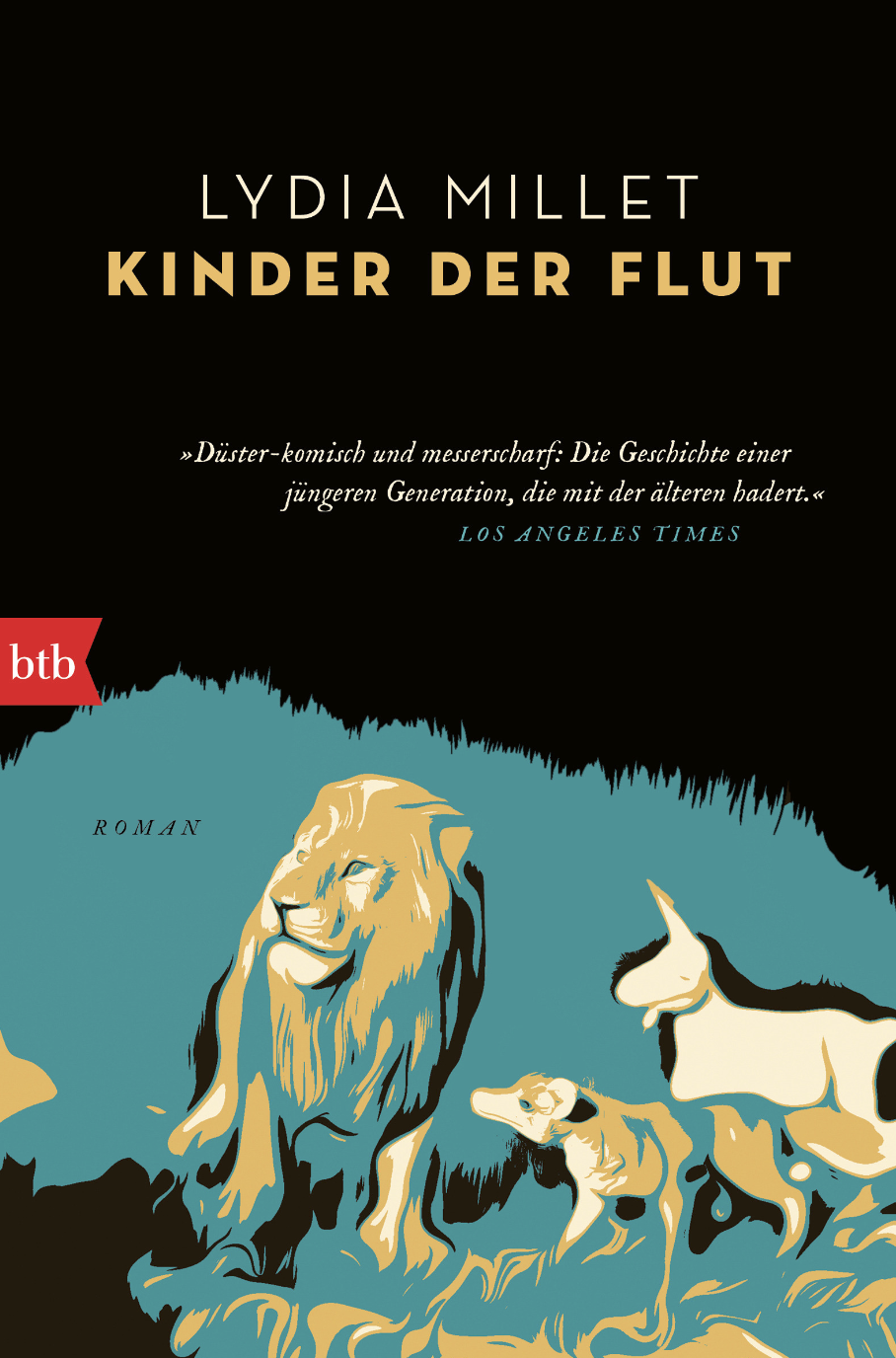
Some climate novels try to persuade you with facts. Lydia Millet’s A Children’s Bible (German title: Kinder der Flut) does something sharper: it asks what happens when a generation has lost trust—in institutions, in parents, in the promise that adults will protect the world they inherited.
The setup is deceptively simple. A group of families rents a lakeside mansion for the summer. The parents drift into a haze of consumption—alcohol, drugs, sex—while the children form their own micro-society on the margins. Then an extreme storm hits, and what was “vacation” starts to look like pre-collapse rehearsal.
Millet’s novel is often described as climate fiction, allegory, even apocalypse—but it doesn’t read like catastrophe porn. It reads like a bitterly funny field note from the edge of an era. The voice is teenage-smart, unsentimental, and watchful; the book’s urgency comes from how plausibly it stages adult denial as a kind of everyday infrastructure.
A generational drama where “the adults” are a failing technology
One of the novel’s most unsettling moves is how it refuses to individualize the adults into sympathetic complexity. They’re not so much characters as a collective habit: avoidance. The children see them as a species of stalled responsibility—bodies that continue, but don’t respond.
That may sound unfair. But as allegory, it’s precise. In climate politics, we often talk about “systems,” “structures,” “incentives.” Millet translates that abstraction into a social form: parents who have the resources to act, and the psychic architecture to refuse acting anyway.
The result is a novel where the crisis is not merely meteorological. It’s representational. The storm doesn’t just break windows; it breaks the story the adults have been telling themselves—that they can buy safety, medicate fear, and wait out the future.
The picture Bible as semiotic engine: when myths become a survival manual
At some point, the narrator Eve notices how scenes of devastation begin to mimic events in a picture Bible carried by her younger brother, Jack. As Kirkus puts it, Jack becomes increasingly obsessed with the Bible as a kind of climate change survival handbook, at one point attempting something explicitly Noah-like.
This is where the novel becomes especially interesting through a visual/semiotic lens. A children’s picture Bible is not just “text.” It’s a portable image archive—a condensed repertoire of floods, plagues, exodus, beasts, covenant, punishment, rescue. When Jack treats it as instruction, he’s doing something profoundly human: reaching for an inherited set of images to make the present legible.
Millet’s trick is that she doesn’t present myth as comforting. She presents it as a cognitive tool that can cut both ways:
- It organizes chaos (“this resembles something I already know”).
- It can also lock us into scripts (apocalypse as inevitability; salvation as external).
- It becomes a mirror for our ethical confusion: if the world is sliding into “Old Testament–style chaos,” what counts as responsibility—care, obedience, escape, sacrifice?
In other words: the Bible here functions the way cultural heritage often functions. Not as a stable past, but as a semiotic resource—an associative repertoire that shapes what feels possible in the present.
Ecofiction that distrusts hero stories (and that’s the point)
Millet is not interested in delivering a clean arc of resistance. The novel’s power comes from its refusal of comforting narrative roles: no easy heroes, no competent adults, no cathartic revolution. The kids do what kids do when left behind by governance: they improvise. They argue. They protect younger ones. They make plans that are both practical and symbolic.
This matters because so much climate discourse is still structured like a blockbuster: villain, awakening, sacrifice, victory (or spectacular defeat). A Children’s Bible is closer to the lived temporality of the Anthropocene: messy causality, delayed consequences, ordinary denial, and sudden breakdown.
Politics of representation: what becomes visible, what stays deniable
There’s a quiet representational argument running under the plot: catastrophe isn’t only “out there.” It’s also in the social management of attention.
In the early sections, the parents’ hedonism isn’t simply moral failure. It’s a media habit: an attention economy turned inward, away from responsibility. The kids’ contempt is not only adolescent rebellion; it’s the clarity of those who can see that the adults have outsourced the future to “later.”
When the storm hits, the adults double down on self-medication, even as conditions worsen. That doubling down reads like a parody of our broader moment: when evidence becomes overwhelming, denial becomes more elaborate—not because people lack information, but because they lack a story they can live with.
This is why the Bible motif is so effective. It dramatizes what happens when the only available narratives are either:
- the soothing myth of endless continuity (“we’ll manage, like always”), or
- the catastrophic myth of revelation (“it was always going to end like this”).
Millet is asking for something else: a narrative ethic that can hold responsibility without melodrama.
Why I’d teach this book
If you teach Environmental Humanities, cultural theory, media studies, or heritage-adjacent courses, A Children’s Bible is an unusually flexible text. It brings together:
- Intergenerational politics (the “who owes what to whom” question)
- Climate disaster without technocratic language (felt experience over jargon)
- A built-in archive of mythic imagery (the picture Bible as visual/semiotic device)
- A sharp satire of adult denial that’s disturbingly recognizable
A few seminar prompts that work well:
- The children’s Bible as heritage object: What does it mean that an illustrated sacred text becomes a survival guide? What kinds of “instructions” do inherited images offer—and what do they obscure?
- Narrative scripts of crisis: Which story templates do we reach for in environmental crisis (apocalypse, redemption, progress, sacrifice)? What are the ethical risks of each?
- Denial as infrastructure: How does the novel portray avoidance not as ignorance, but as a social system—kept running by privilege, intoxication, and the refusal to imagine change?
Final note: a small book with a large diagnostic ambition
A Children’s Bible was a finalist for the 2020 National Book Award for Fiction, and that recognition makes sense: it’s compact, furious, and strangely tender toward the children who inherit the mess.
But what stays with me isn’t only the storm. It’s the book’s central provocation: we live inside image-archives, whether we admit it or not. When the weather turns biblical, the kids don’t reach for policy briefs. They reach for pictures—old stories, familiar signs, inherited scripts—and try to read their way into survival.
That act of reading is not naïve. It’s human. And it’s exactly why ecofiction matters: it trains the cultural work of interpretation, the ethics of attention, and the imagination required to build futures that are not simply repetitions of our worst myths.
Lydia Millet, Kinder der Flut, novel, German (translated by Elke Link), 256 pages, Munich 2024 (btw), € 16.00 (D), ISBN 978-3-442-77390-9.
Lydia Millet, A Children’s Bible, novel, English, 240 pages, paperback, New York 2021 (W. W. Norton & Company, Inc. ), USD 15.95, ISBN 978-0-393-86738-1.